I was inspired to train my cats to go camping after an amazing three-week trip to Canada in my rooftop tent. I was having such a great time and would have loved to keep traveling, but my two fur-babies at home made me return. That’s when I started figuring out how they could join me on my adventures.
For those people that are cat parents, it is not as easy as just putting your cats in the car, van, or RV, and you are ready to go. You need patience to train your furry felines to adjust to collars, harnesses, and a vehicle. In my case, it is a campervan.
I have been a parent to multiple cats and every cat is different. I had to adjust what I was doing to make sure it works best for them. Here is what I did to train my cats and some adjustments I made to travel with my fur babies:
- Introducing my cats and their personalities
- Harness and collar training
- Van training – Before going out on any long camping trip, I gave Tolo and Trout time to become familiar with the van and took them on a mini-camping trip to see how they would do
- Modifications I made to the van to ensure they traveled comfortably and minimize any accidents
- How I made the actual trip easier on them – same litter, same food
- Tips to help them avoid cabin fever
- What I include in my kitty-kit – grooming and first aid
My Furry Felines
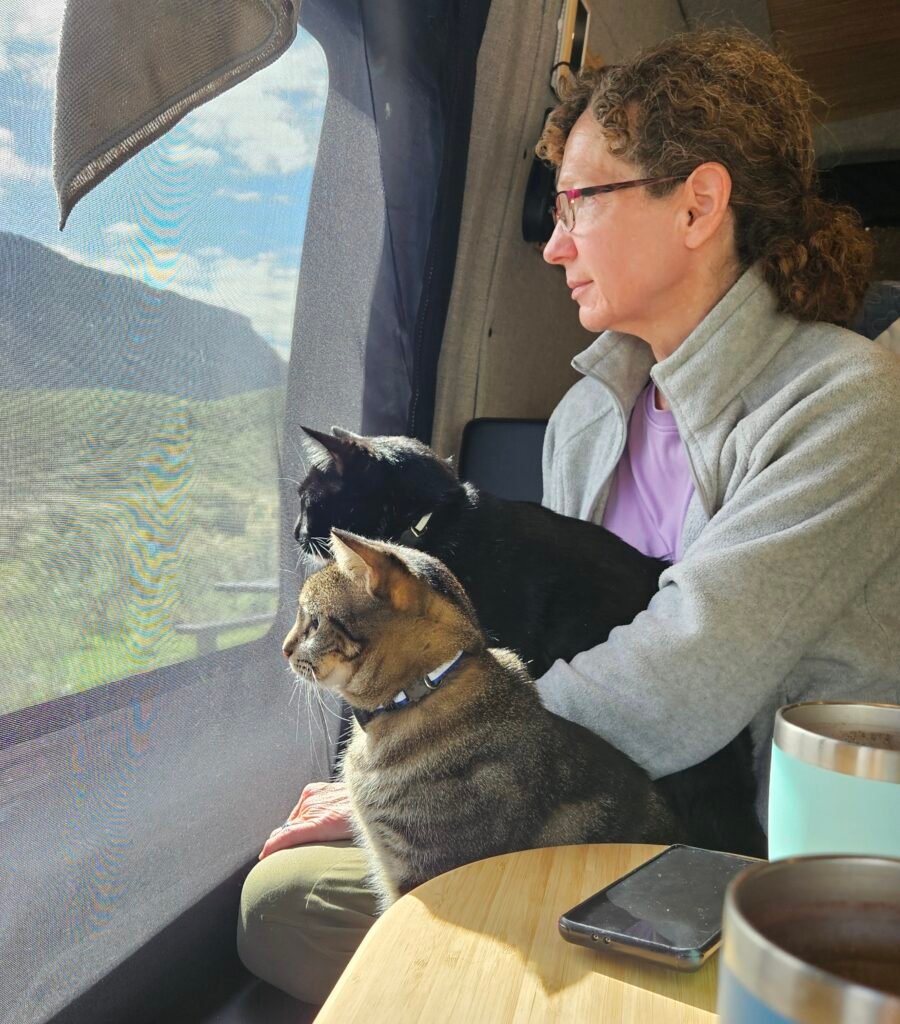
Here I am with Tolo (Tuxedo) and Trout (Grey Tabby). They are fascinated by a pair of Mule tail deer that happen to come into my campsite during breakfast.
- I adopted them both from a rescue in October 2021, and they are a bonded pair.
- When not out camping, Tolo and Trout are indoor only
- Anytime someone comes into the house, they run and hide
Harness and Collar training
When training a cat, find your happy place. Take your time and think baby steps. Here is how I taught Tolo and Trout to wear a harness and a collar:
Harness training – I initially had them wear their harnesses for 15-20mins at a time to not over stress them. I played with them or put the leash on and “walked” them outside. Whatever I could think of so they would focus on what was going on around them and less on the harness. It took a few tries, but eventually they both associated the harness with play or going outside.
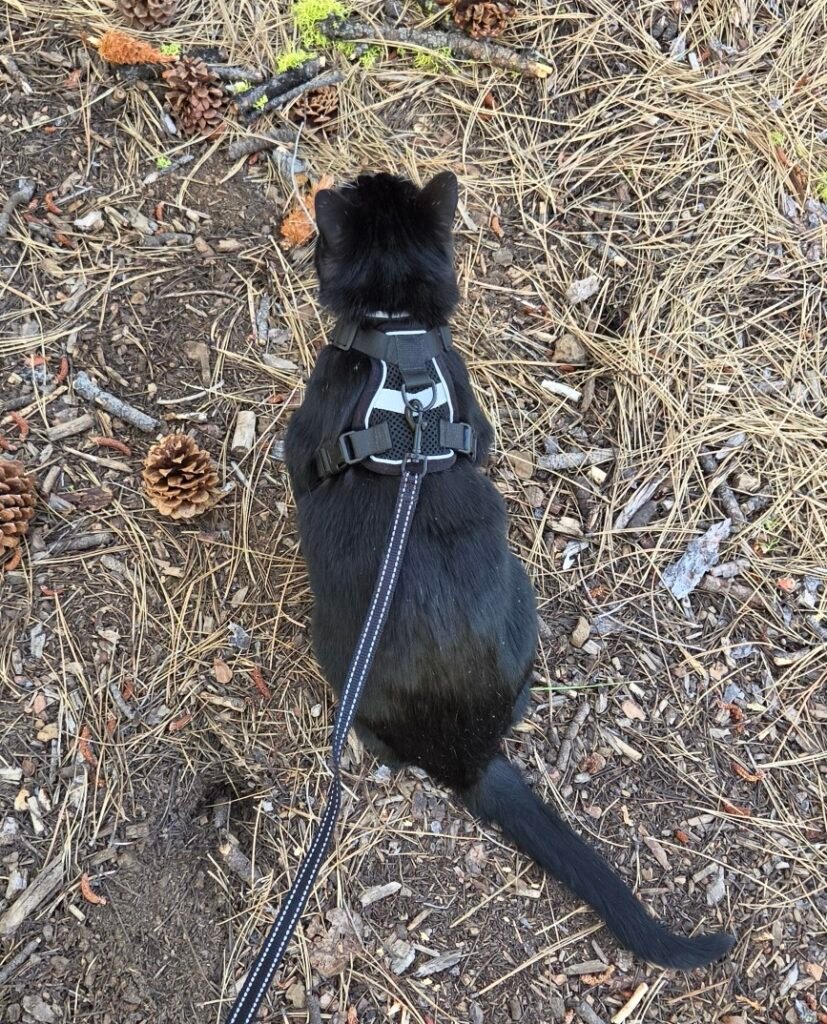
When I first put the harness on Tolo, he walked around on his “tippy toes”. I have never seen a cat do that before.
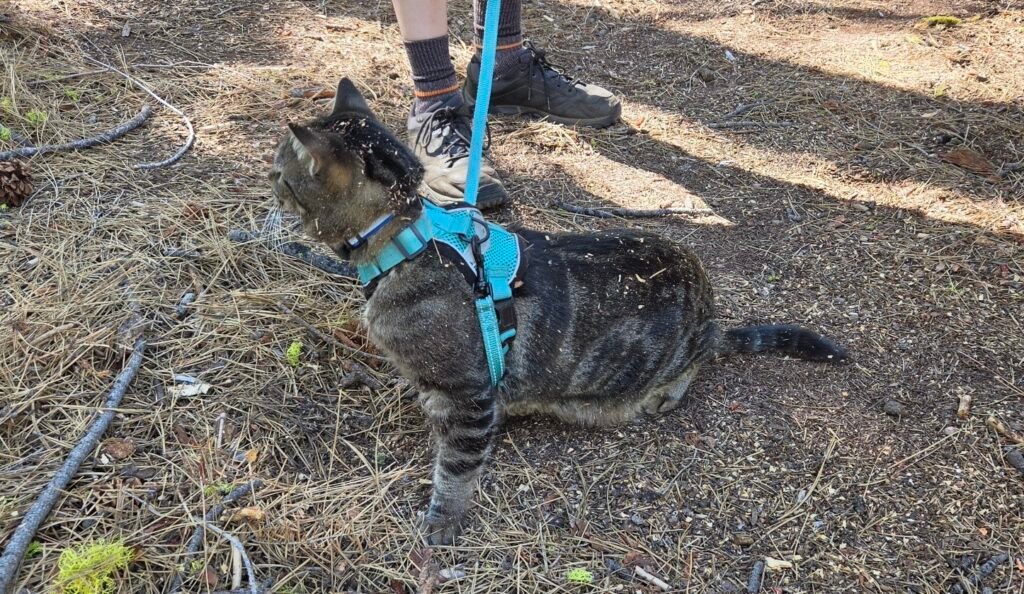
Trout’s first experience with a collar had him walking low to the ground like he was carrying a heavy weight. Once he adjusted, I discovered that Trout loves rolling around in the dirt!
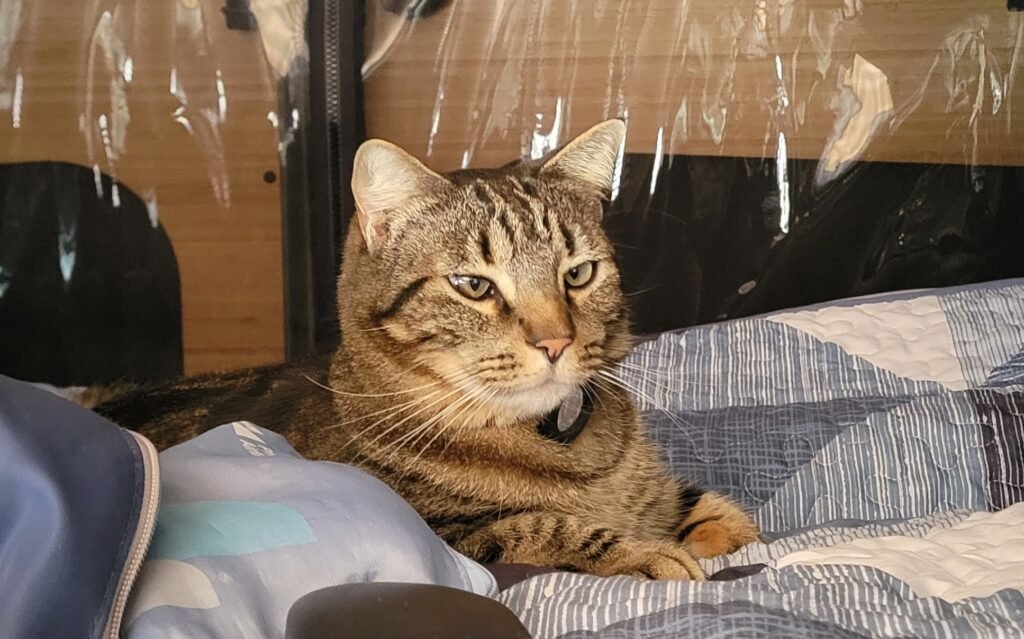
After they successfully “passed” the harness training, adding a collar was easy. I made sure they wore collars with an Air-tag holder so if they ever escape, I can find them.
- When I go to bed at night, I cannot leave the van because Trout wants to escape! To give my fur-babies a break, I remove their collars when I turn off the lights and then put the collars back on when I get up in the morning.
They wear the harness whenever I am driving or if I am planning on taking them out for a walk. Otherwise, they wear just their collars. I have worked with them to associate the campervan as a safe home base. That way if they do escape, they want to come back to the van because it is safer than being outside.
Van Training
Before buying the camper van, the longest road trip Tolo and Trout were on was a 6-hour car ride. They did not eat, drink, or use the litter box the entire time! That approach won’t work when camping out of a vehicle for weeks at a time.
Van training comprises of familiarizing them to the van as well as adapting them to camping out of the van. I needed to ensure they ate, drank and used the litter box – both #1 and #2.
Familiarizing them with the van
Before Tolo and Trout go into the van, their harnesses and collars go on.
- Van training – I first started with a few sessions of 2-3 hours at a time in my driveway. I would just hang out with them by surfing the web, playing games on my phone, etc. This worked okay; however, they could see the house, and they knew where the front door was. This meant they advanced to riding in the van.
- Before taking them out on a ride, I plugged in a Feliway Diffuser (glad I had an AC outlet in the van) as well as sprayed Feliway in the general area they would be. Then, I took them on a couple 3–4-hour drives. This allowed me to find what spots they liked so I could arrange and update those with cat beds. During these short rides, they still did not eat, drink, or use the litter box even though I made sure Tolo and Trout knew where they were.
First time camping
The first camping trip turned into a learning experience for all of us. After reading other people’s experiences where their cats would not eat or use the litter box, I chose a campsite an hour from my house. I wanted to ensure I was close enough to home that if one of them had an issue, I could pack up and go home and/or a vet. To be honest, I did not sleep the night before our camping trip.
- Before bringing them into the van, I again used the Feliway Diffuser and Feliway Spray to help calm them down. I didn’t even make it to the end of the street before Tolo peed in his cat bed…. So, turn around, change out the bedding, and then leave and try again. Not a good start.
- Day #1 – arrived at the camp site and settled in. I learned Trout takes out his stress and feelings on his brother. This is exhibited by hissing, spitting, and swatting/attacking Tolo. Trout did this ALLLL night long and none of us got any sleep. At this point I am wondering if I just made a huge mistake!
- Day #2 – I woke up in the morning to find their drinking water was down, their food bowl was eaten, and they used the litter box- WOOHOO!!! Major hurdle checked off. I turned off the plug-in Feliway Diffuser, and they didn’t seem to behave any differently. One less item to pack. For Night #2, Trout was better. He only hissed, spit, and attacked his brother once at 6am.
- Day #3 – since things improved the previous night, I decided to camp one more night. It was the right choice because up to this point, I had the entire campground to myself. For the last day other campers started to arrive (new experience!). Also, it rained which generated new sounds in the van they were not used to. For night #3, all of us had a good night sleep and when I woke up in the morning, I decided they graduated “Feline Camping Accademy” and were officially ready for a real camping experience.
Here are a couple of pictures of my 2 furry kitties during the trip. It was nice to see Trout finally calm down and enjoy himself.
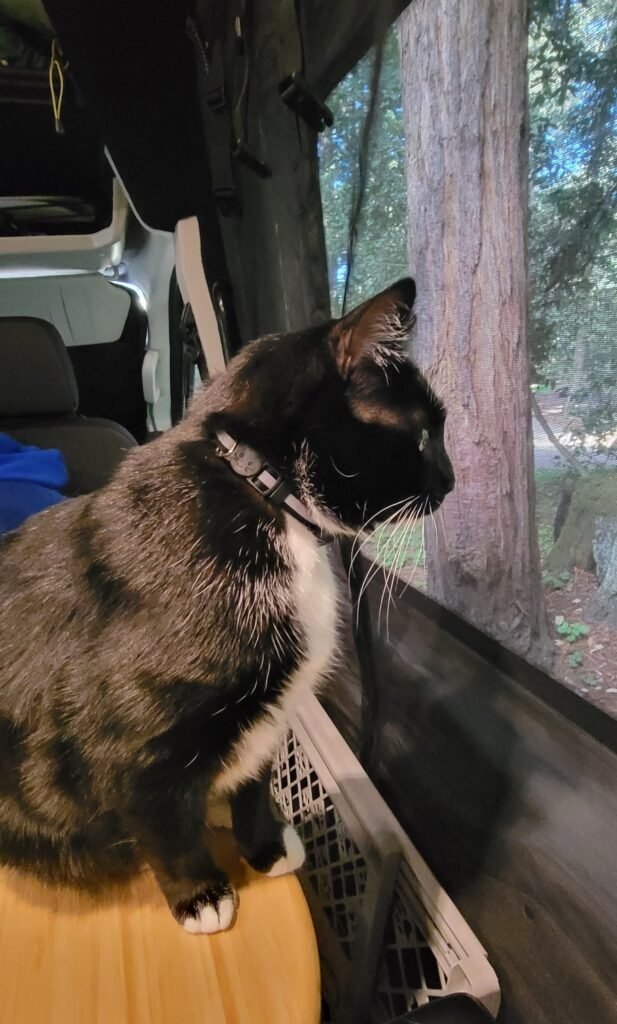
Tolo watching birds and squirrels outside. He is sitting on my eating table, so it was a challenge keeping him off it during mealtime.
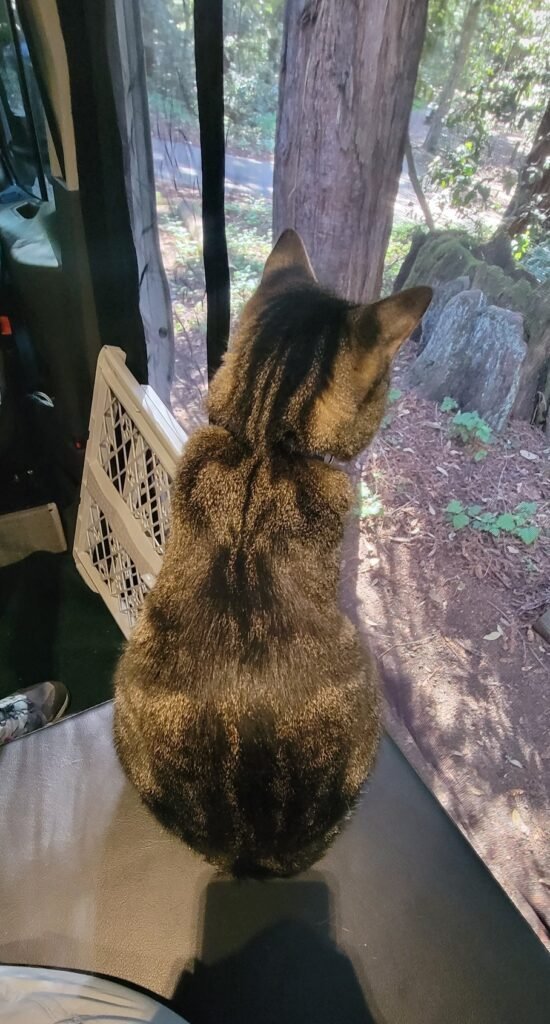
Trout enjoying looking outside and fresh air. Using my bug screen, I jury-rigged a pet gate with a tension rod so they could have some fresh air, enjoy looking outside, yet could not escape.
Van Modifications
When traveling with cats, I looked at the van and thought through how to make them comfortable.

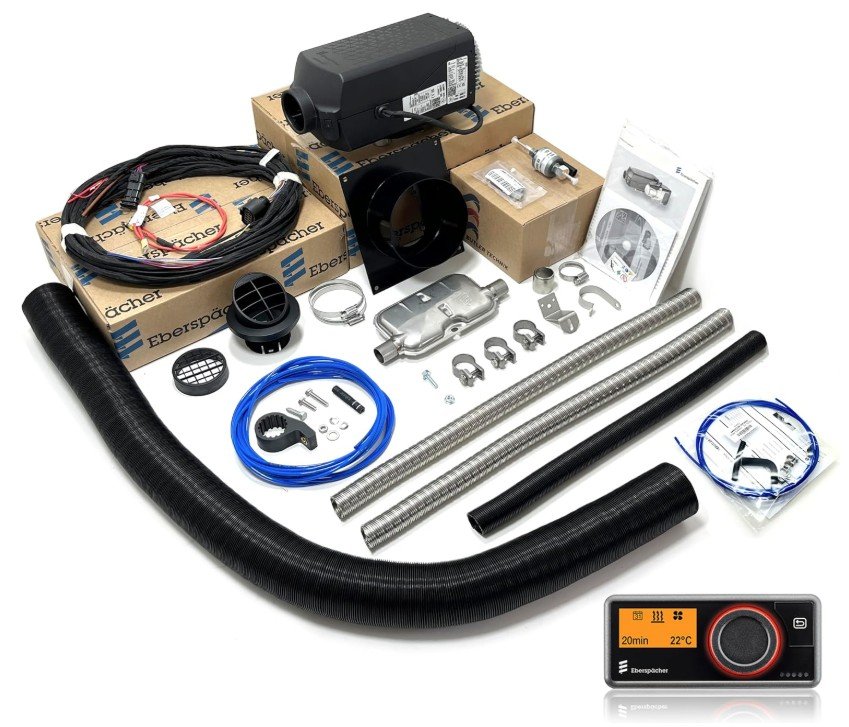
The first area to address was the HVAC. Any vehicle, even with insulation, can be quite hot or cold. So, I paid the extra $$ for the 48V Velit AC for hot days, Espar Heater for cold days, and additional solar to handle the increase in power draw. I have now camped with both Tolo and Trout in the snow and heat, and I am relieved to have both to make sure they are comfortable in the elements.
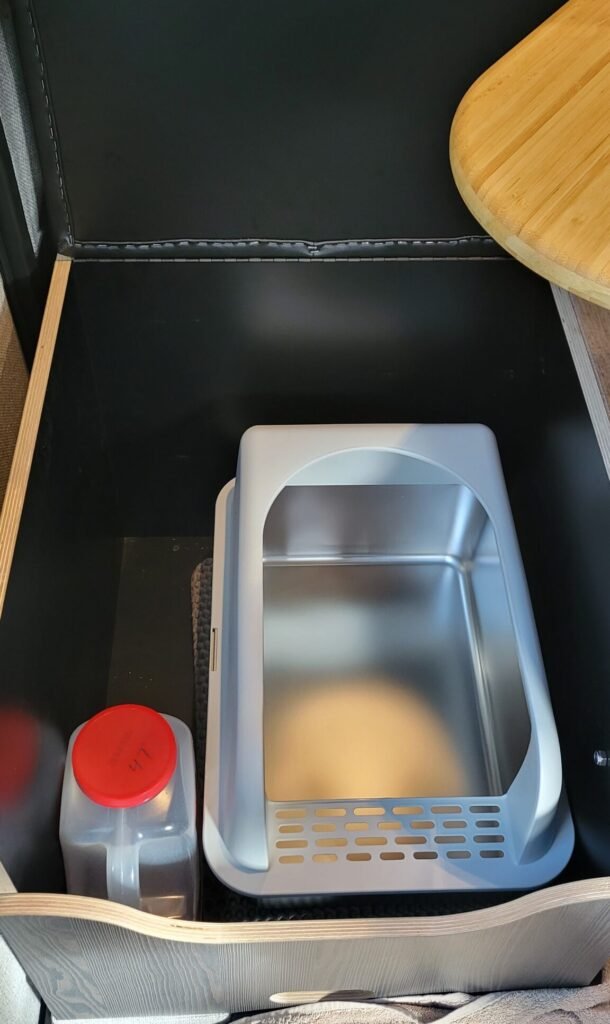
The litter box is one of the most common questions I get. Do I have one? Where did I put it? My layout came with a cabinet that included a cassette toilet. I removed the toilet and replaced it with a steel litter box. I chose steel because it helps reduce odor, unlike plastic which can absorb litter smells. Since the boys now have their own toilet and I don’t, I make do with a wide-mouth water bottle and/or a foldable toilet seat with a bag. Ah, the things we do for our furry felines.
What have I done internally to adapt to the boyz?
- After reading people’s comments that their cats will pee on the bed and Tolo likes to randomly pee when he is unhappy, I bought a waterproof fitted sheet to protect the custom mattress that came with the van. I use it instead of a mattress cover, and I place my actual sheets over it. This fitted sheet does not make noise like some waterproof sheets/covers do, which is nice.
- Observing how Tolo and Trout moved about the van, I noticed they did not like the feel of the campervan floor. To solve that problem, I bought 2’x3′ soft bath rugs from Costco to be more comfortable on their feet.
- I added a lightweight quilt/comforter to the bed to minimize the risk of them rolling or sliding off.
- I placed a camping mat outside the litter box, and I discovered it is great for easy litter cleanup! The original plan was to use it when the sliding door was open. When I saw how well it trapped litter and then fell out when I shook it, it now has a permanent home. I have since bought a second mat for going in and out of the sliding door.
Adjusting to Camping
Camping out of a van is a big change for them, so I tried to keep as much as I could that felt familiar to them.
- Same litter as home and packed extra to cover the entire trip. If necessary, I sprinkle the same Arm and Hammer deodorizer as home, so they are familiar with the smell.
- Same food as home and pack enough to cover the entire trip. I did not want to assume I could find their specific food when on the road, and cats are very sensitive to sudden food changes.
- For water I was hoping the van water would be good enough; however, I brought a gallon of drinking water just in case. I was lucky – they drank the filtered van water!
- Their favorite toys – once they became comfortable in the van, they wanted to play!
- Trout’s favorite toy is a laser pointer
- Tolo has his favorite butterfly on a stick
- A round toy with cardboard and a ball is also a favorite and doubles as a place from them to sharpen their claws
- A few miscellaneous balls and cat nip toys are also included, just because
Avoid Cabin Fever
Going from a house to a 6’x10′ confined space for multiple weeks can cause some “cabin fever”. So, how do I minimize that?
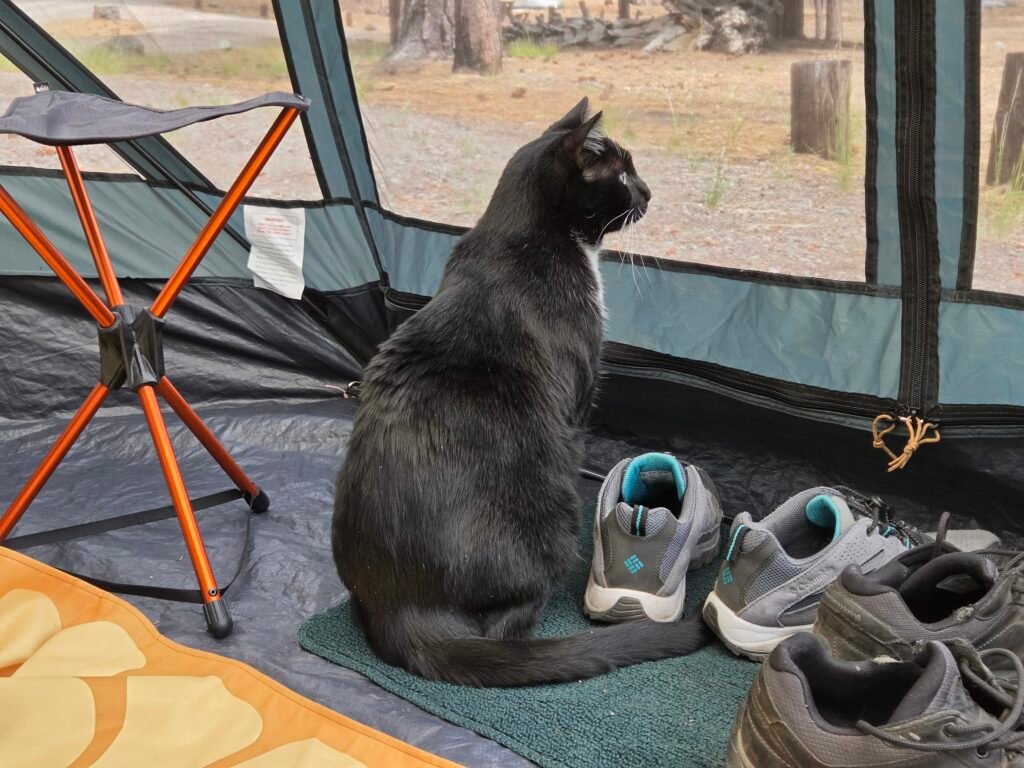
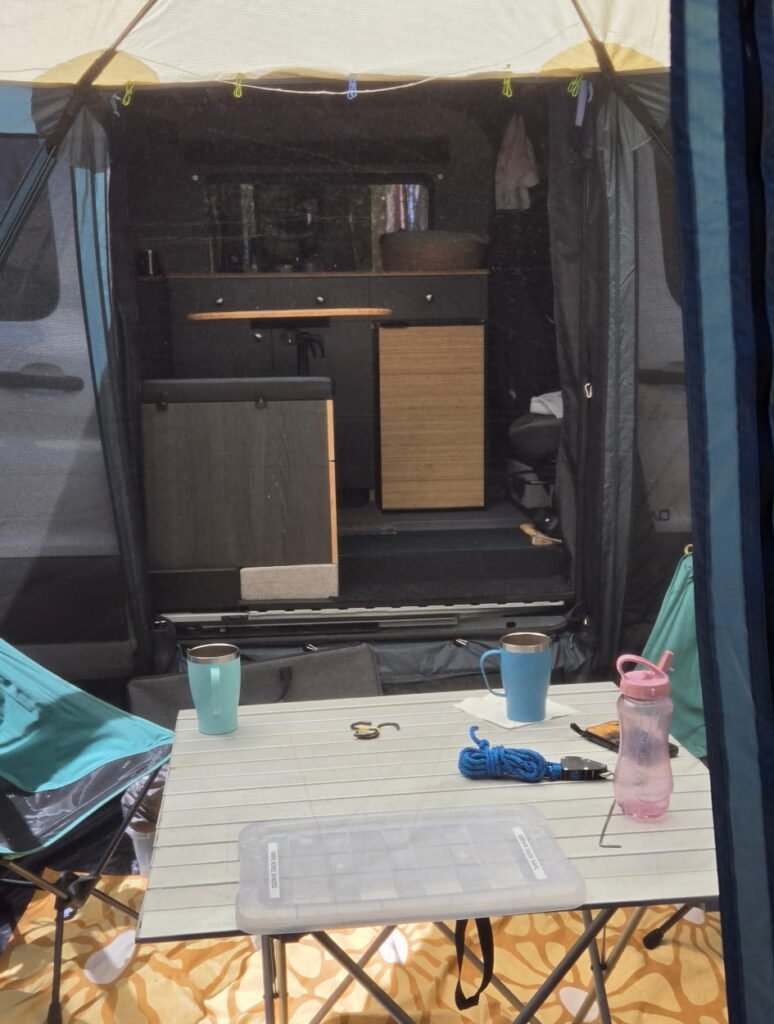
I bought a Pop Up Gazebo Tent with a bathtub floor that I attach with magnets to the van. It is large enough for me to be outside with them, and they have a little extra space to roam. After the first long camping trip, I modified the gazebo to have a second, wider door to attach to the van. WHAT A DIFFERENCE! I can use the large sliding door versus always going out the driver seat. If you decide to go this route, then look for a gazebo with two doors, if you can.
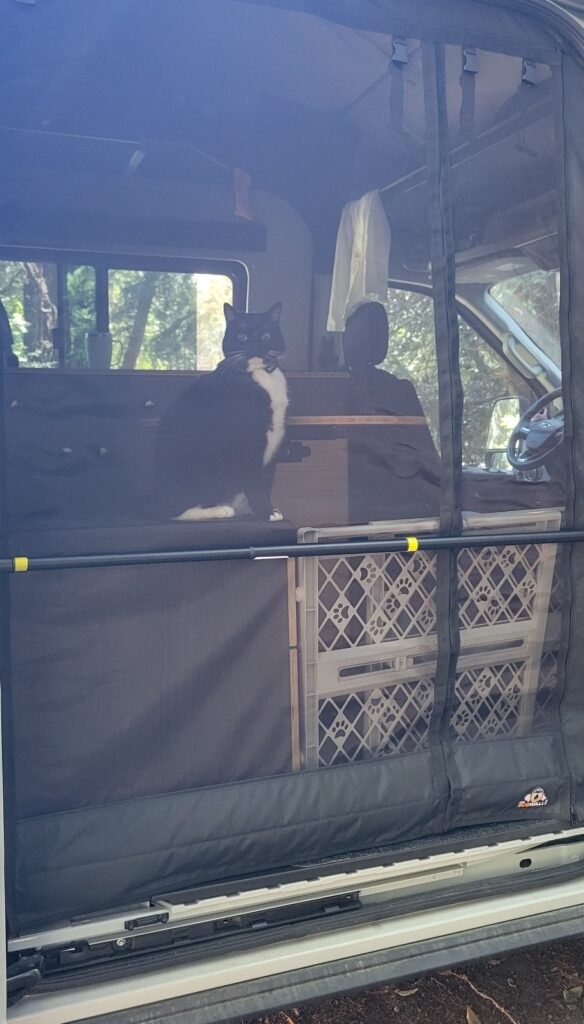
I engineered my Bug Wall screen with a MYPET pet gate on the inside, and a tension rod on the outside. I use strong magnets to hold the rod in place. This setup allows me to open and close the door without changing anything. When I stop some place, I just open the door for them so they can see out and have some fresh air.
If I feel it is safe enough, I take them out for a walk with their harness on. While they are exploring, I am constantly watching for potential issues – dogs not on a leash, tall grass with potential ticks, or prevent them eating something that might be poisonous. So far it has all gone well and I have had no issues.
Kitty Kit
Kitty Kit- make sure you have any cat supplies (including their vaccination records) in a dedicated bag, pouch, etc. Here is what I have in my kitty kit
- Vaccination records – particularly their rabies vaccination dates
- Brush
- Comb
- Nail clippers
- Revolution Plus for flees and ticks
- Essential 6 drops – Tolo has a skin allergy that randomly kicks in. We make sure we have a few doses of this to ensure it keeps his allergy at bay and he feels better
- Ear Drops – Trout had an ear infection, so I packed this in case it comes back
- Antibiotic Ointment – Trout (again) had an issue where he needed a topical antibiotic. Since I had left over, I put that in the kitty kit just in case I needed it and did not have access to a vet.
In addition to the Kitty Kit, I pack 2 collapsible pet carriers in the event I need to take them away from the van – vet, hotel and a “cone of shame” for just in case.
My two boyz have joined me on a few camping trips now, and they have done really well! Hopefully my suggestions and learnings above help you train your furry felines to go out and camp with you.
Some of the links in this post are affiliate links, which means I earn a small commission at no extra cost to you if you make a purchase. Thank you for supporting my website! – Lori